
What is theme-based learning?
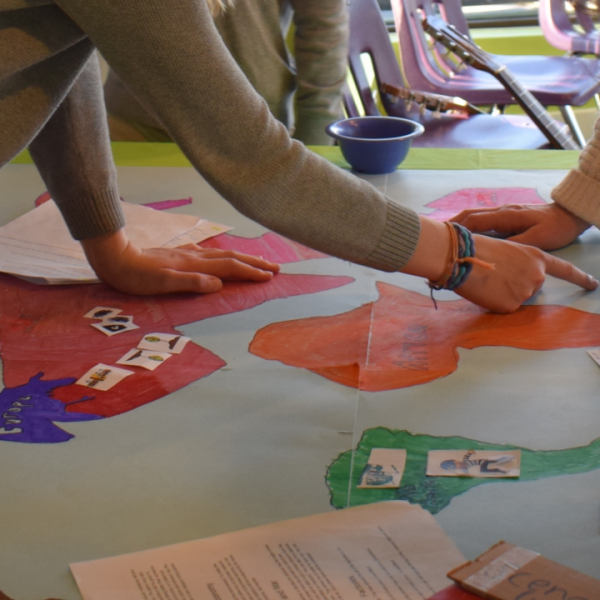
Over the last few years, I have been privileged to be able to teach diverse pedagogies that directly align with my teaching philosophy. One of these pedagogical approaches is theme-based learning, which is an approach that integrates many curricular subject areas into one relevant, current, and age-appropriate theme or big idea. For example, in my grades 5-7 class I taught themes on plastics and oil, urban design, energy, sports science, social justice, identity, fashion, forests, evolution, globalization, natural resources, and addiction. Through these themes, I design projects and activities that meaningfully integrate the curriculum, including both the skills and content. I find that theme-based learning perfectly complements the new, revised BC curriculum; it creates a more coherent, thorough, and rigorous learning experience for students that naturally allows for differentiation.
Theme-based learning is a pedagogical “vehicle” that facilitates real-world and interdisciplinary learning, allowing teachers to weave in student-centered pedagogies, including inquiry, experiential, place-based, play-based, and project and problem-based learning. This pedagogical mindset also allows teachers to move away from checking curricular boxes to creating meaningful learning moments that are rich, and supports deep and authentic learning.
How do you choose a theme?
I recommend that you draw inspiration for your themes from your provincial/state curriculum. You may pull thematic inspiration from the Social Studies and Science content of your grade-level. Then, you can focus on integrating numeracy and literacy, skills development, in context. I also recommend following the news to see what is current and relevant for your age level; learn about what “local” connections may impact your students. You can also consider the season to extend your learning beyond your classroom walls, perhaps spring or autumn is an ideal time to integrate outdoor learning through forest visits by conducting science experiments and developing observation skills, or perhaps there is an upcoming municipal election you want to connect to an urban design or social change theme. At the school I teach at, Pear Tree school, we teach several themes at one time, and we explore each theme for about ⅓ of the school year. For example, I teach three themes in the fall and spring terms, and two themes in the winter term. This allows my students to practice their literacy and numeracy skills on a regular basis, as some skills favour certain theme areas; for example, my sports science theme integrated mostly Math, Science, and Design; whereas my addiction theme integrated English Language Arts, Social Studies, Arts, and Health Studies. But taught in parallel, they would nicely complement one another in terms of skills development.
How do you plan a theme?
Firstly, I hone in on a big picture idea (note: for BC teachers this is different from the curricular big ideas). The big picture idea provides the “why” behind a theme; it narrows the scope to a relevant, current, and meaningful intention. For example, the big idea of my urban planning theme was for students to “learn how to see the city as an Urban Designer and assess to what extent Vancouver is a liveable and sustainable city.” Once I develop my big picture idea it is easier to begin intentionally narrowing key content and skills development foci for my students.
Next, I use backwards design to create a skeleton of my theme. I think about what types of problems I want my students to solve and projects that can extend my students to show their thinking and learning at the end of the theme. Then, I consider which skills, particularly numeracy and literacy skills, my students should practice and develop in relation to the assessments and the big idea.
Thirdly, I conduct a local/global scan. This includes a fair amount of research. Since I am not an expert in any one field, I dive deep into the literature by looking through different lenses and perspectives at how I might approach my big idea. This step always gives me inspiration for larger assessments and projects, and potential field trips. Speaking of field trips, I encourage you to think outside the box and consider non-traditional field trips that are set-up specifically for educational purposes. For example, during my plastics theme after completing a zero/low waste challenge, we visited Vancouver’s only zero waste cafe, Kind Cafe, for lunch and a “talk” with the founder. Field trips and guest speakers are a meaningful way to connect students to their local community. As you conduct your local/global scan, keep track of useful articles, videos, books, and data that may be relevant to weave into your classroom. Different lenses you might consider in this step are current events, geographical, historical, or social justice lenses.
Lastly, I encourage you not to overplan; certainly, plan some activities and lesson plans, but stay flexible and open, so you can adapt to what your students are interested in. I found it difficult to let go during my first term teaching theme-based learning, but now I am constantly adapting my plans to the learning needs and interests of my learners.
What might a theme look like?
Theme: Urban Design
Grades: Combined 5-7 (Content from Social Studies 6)
Big Idea: To learn how to see the city as an Urban Designer and assess to what extent Vancouver is a liveable and sustainable city.
Field Trips and Guest Speakers: Teacher-led walking tour of olympic village (a sustainable neighbourhood); Vancouver Urban Planner guest speaker; energy facilities; and engineered landfill, urban architecture walking tour, and gentrification in Chinatown walking tour
Curricular Areas: Applied Design Skills and Technology; Social Studies; ELA; Math; and Art
Major Assessments and Activities:
- Geometry and financial literacy (Problem-based learning) – Students measuring the combined area of all the classrooms (irregular shapes and curved) to find out how much paint would be needed to repaint the walls and carpet for the floors. They also calculated the cost, including taxes and discounts.
- Graphing and data analysis – students explored different trends in housing, zoning, energy costs, etc. in Vancouver and across Canada.
- Designing a neighbourhood in Vancouver that is both liveable and sustainable. Students presented their designs to the City of Vancouver as part of the Vancouver Plan consultation process (authentic design thinking).
- Design Hack – students interviewed the faculty to find out their needs. They then pitched a solution to suggest how a new, underused space at the school can be designed. (Design Thinking, Math, ELA, Social Studies)
- Student Vote – to prep for the student vote, students conducted research and practiced their public speaking skills through presentations and debates (ELA and Social studies)
- Gentrification in Vancouver Research and Role-Play – students researched and took on an assigned role in our class-wide role play (Perspective-Taking [SS] and Drama).
Two more points I would like to mention are that you can still teach skills in isolation; not all skills have to be directly related to the theme. Students need to learn and practice these skills, but then the students’ learning can be extended by applying these skills in context. Secondly, if you know me, I am obsessed with higher order thinking, and pushing my students to become critical and creative thinkers; therefore, I find that theme-based learning is an effective approach to teaching thinking skills in a relevant way; students naturally begin to make connections between topics and across themes; they naturally begin to become systems thinkers.
If you want to learn more about theme-based learning or if you want to share your own experience with this pedagogy, I would love to connect! Please reach out or comment.


Leave a Reply