
Over the past few years, I have had the privilege of guiding Grade 6 and 7 students through a powerful learning journey that explores personal identity, school experiences, and how we learn best. We’ve returned to this unit multiple times, this school year and three years ago, because it continues to spark reflection, build empathy, and deepen classroom community in meaningful ways.
The central idea of the unit is this: when students better understand themselves as learners, and understand the people around them too, they are more able to thrive. They become more confident in their strengths. They also become more compassionate toward the challenges of others. This unit creates space for those realizations to happen.
We begin with the theme of identity, especially in the context of school. Students think about how they learn, what motivates them, and what barriers they face. We co-create classroom norms to shape a brave space—one where students feel safe being honest and are encouraged to reflect openly. Together, we build a community that values growth, kindness, and collaboration.
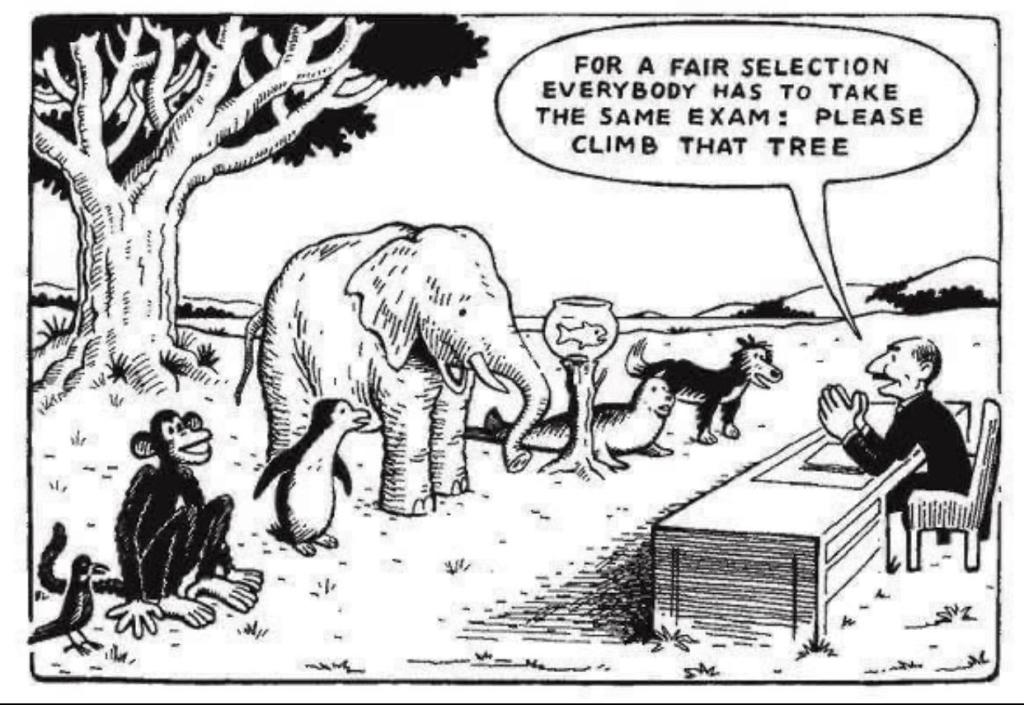
The heart of our work is the novel Fish in a Tree by Lynda Mullaly Hunt. The story follows Ally, a girl who struggles in school until she finds people who see her differently and help her recognize her own brilliance. Before even reading the first chapter, students make predictions about the book’s cover and title. This leads to an important visual discussion based on the comic inspired by the quote often linked to Einstein: “Everybody is a genius. But if you judge a fish by its ability to climb a tree, it will live its whole life believing that it is stupid.” The comic shows animals being tested in the same way, even though they are all completely different. It sets the stage for everything we’re about to learn.
Reading the novel happens through many formats. Sometimes I read aloud to model fluency and thinking strategies. Other times students read independently or in small groups. Each week, we hold literature circles. These groups are student-led and involve rotating roles like the “Themeinator,” “Symbolist,” “Conflict Catcher,” or “Summarator.” These roles guide students to analyze the novel in different ways. They do more than just check for understanding. They push students to explore character motivations, big ideas, and key moments of conflict and growth.
Students also learn to connect what they read to their own lives. As we read, we look at the idea of learning profiles. What are your strengths? Where do you stretch? What kinds of support help you thrive? These questions are woven into written reflections, visual projects, and conversations. We also introduce multiple intelligences and learning styles, which help students notice patterns in how they think, communicate, and process information.
To make these ideas more concrete, we study how the brain works. Students explore neuroplasticity; the idea that the brain can change with effort and practice. We talk about motivation, attention, sleep, and nutrition. We look at common learning differences like dyslexia, ADHD, and autism. Through videos, nonfiction readings, and thoughtful discussion, students begin to see that learning challenges are not about being less capable. They are about understanding the right tools, supports, and environment. This work helps students become more empathetic. They realize that just because someone learns differently doesn’t mean they are any less intelligent.
Some of these learning profile activities were first co-created with my English 8 teaching team at Collingwood with Katie Anderson and Brad Jollife. I then adapted them for younger learners. They became essential parts of our journey and worked beautifully with both groups I’ve taught.
All of this learning led to one of the most meaningful projects we’ve ever done: a personal documentary film. Each student created their own short documentary to reflect on who they are as a learner and what helps them succeed. These documentaries brought together all the threads of our unit: identity, self-awareness, empathy, storytelling, and voice.
To prepare, we studied the art of documentary filmmaking. We learned about camera angles, types of shots, music and sound effects, and how editing shapes mood and meaning. We practiced storyboarding and script writing. We explored the design process from brainstorming to rough draft to revision. Students were introduced to iMovie and learned how to make smooth transitions and polished final cuts. Many students added metaphors, similes, or symbols to deepen their message. Others used music to set a personal tone. Every student brought their story to life in a way that was entirely their own.
When the films were ready, we held a classroom screening. We invited our specialist teachers and support staff, so that they could also learn about our students in new ways. These screenings were emotional and inspiring. We laughed together. Some of us cried. But more than anything, we listened. We gained a deeper understanding of what each student needs to thrive at school.
The documentaries were more than just a project. They became tools for inclusion. By sharing their stories, students gave their classmates insight into who they are. It helped build empathy and reduce conflict. Students began to make more thoughtful choices in how they work together. They respected each other’s limits. They offered help more freely. They leaned into their own strengths and allowed others to do the same.
It’s hard to put into words how transformative this work has been. The Grade 6 and 7 students I’ve done this unit with have shown tremendous maturity, vulnerability, and care. They became more connected as a class. They also became more confident in naming what works for them and what doesn’t.
In a world where school can sometimes feel like a place where you have to fit in, this unit offers something different. It invites students to stand out, to understand themselves, and to celebrate how others learn too.
And that, to me, is real learning.
 Katelyn Jmaeff's Blog
Leave a comment